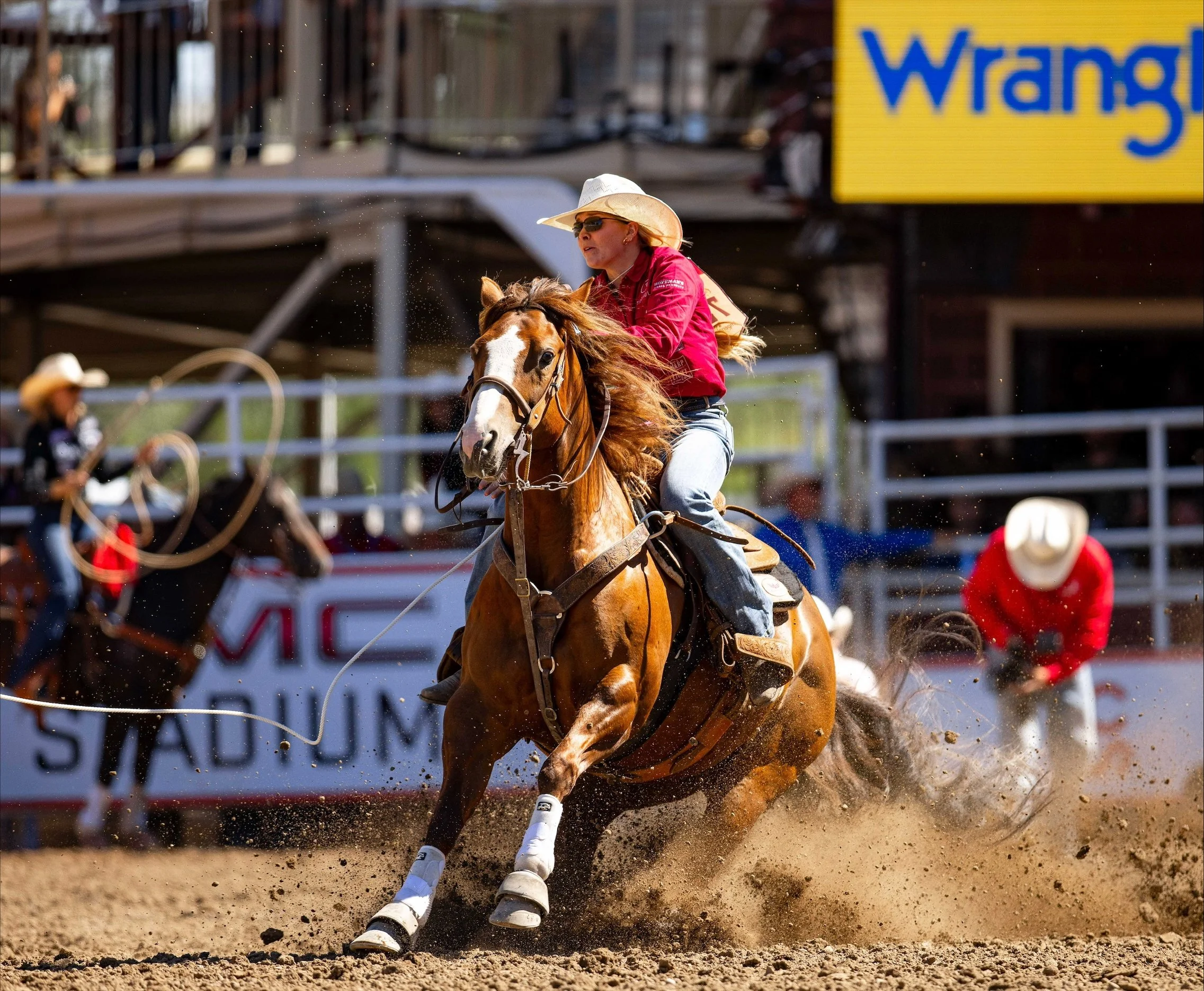
Mikenna Schauer CFR 2026
Quick Info
Horse:
Registered Name: WIMPYS LIL STAR
Barn Name: Kat
Sire: WIMPYS ROYAL KING
Dam: VONEETA STARLIGHT
Rodeos Entered: 43
Total earnings: $19,164.38
CFR qualification #: 4
Saddle: Cactus Calf Roper
Pad: Cactus Saddlery Relentless Extreme Gel Pad
Bit: TM 60 / ML Low Port Correction with Court Nugent chin strap
Rope: Classic Viper 10.0, Classic Striker 10.0, and King Ropes Polygrass 4-Strand
2026 CFR Interviews Presented by Alliance Equine
Mikenna Schauer is an Alliance Equine sponsored athlete!
What was your most memorable run of the season, and what made it stand out?
My most memorable run was definitely the second round at Ponoka. I think any run at Ponoka is memorable just because of how unique it is running down that alley, but this one especially stands out because it was probably the most mud and rain I have ever competed in. We had already roped in the slack earlier and were all in our shotguns, chaps and rain hats, cold and a little bit miserable. I ended up being the fastest in my set in the second round, which got me back to the short go. Between the atmosphere at Ponoka, the mud, the rain and everything else going on, it was just one of those crazy runs that I will always remember.
Looking back at your season as a whole, what are you most proud of?
I definitely didn’t have the season I had hoped for, and there were a lot of highs and lows. It was my first full season riding Kat, so we were also still learning each other and figuring things out along the way. I really worked on not letting the highs get too high or the lows get too low and taking each run for what it was. More than anything, I am proud that I stayed mentally tough, kept showing up and continued trusting myself and my horse through the tougher stretches of the season.
How have you changed as a competitor since your first CFR?
I think I have changed a lot, especially mentally. My game plan for a season has evolved, and I am still learning what works best for me because rodeo is so unpredictable. This year especially, we dealt with a lot of bad weather, rain and muddy conditions, and you have to learn to adapt to whatever is put in front of you. I think my mental game has improved more than anything, and I have learned that being able to stay level headed and adapt is one of the most important parts of being a successful competitor.
Has your definition of a good season changed over the years?
I actually don’t think it has changed that much. Growing up through junior rodeo, high school, college and now professional rodeo, I have always felt that a good season comes down to consistency. Winning rodeos is obviously a lot of fun, but you aren’t going to win every time. To me, a good season is consistently doing your job regardless of the weather, the setup or the animal you draw, while keeping yourself and your horses healthy and enjoying what you are doing. If I can finish a season knowing I consistently gave myself the best opportunity I could, I consider that a good season.
What’s the hardest part about chasing the CFR dream that most people don’t see?
Probably everything that happens between the actual runs. There are a lot of long nights, all night drives and times when you pull into a rodeo on a few hours of sleep and still have to be ready to compete at your best. You are also balancing work, practicing, keeping horses feeling good, keeping yourself healthy and dealing with bad runs, slumps or horse issues along the way. I think being able to bounce back from all of those little things and still show up ready to compete is one of the hardest parts that people don’t always see.
What did you learn at last year’s CFR that you’re bringing with you this year?
Consistency. Winning the aggregate last year without winning a single round really reinforced that for me. I don’t have to go into every round thinking I need to win it. I need to take the first good shot I see and make the best run I can each time. Five consistent runs can pay off in a big way at the end of the week, so that is the mindset I am bringing back with me this year.
What’s one quality your horse has that you wish you could bottle and put into every horse?
Her try and her grit. I never have to wonder whether Kat is going to give me everything she has in a run. It doesn’t matter if we are roping in mud, heat or a completely different setup, she shows up and tries for me every single time. That is something you can’t really teach a horse, and I wish I could put that quality into every one of them.
Do you prefer the training or competing side of the process more, and why?
I think I actually prefer the training side. There is something really rewarding about looking back and seeing all the progress you have made with a horse. You spend years working on all these little pieces, and eventually they start coming together and you have a horse capable of competing at the professional level. Knowing that I have the ability to develop a horse to that level and then turn around and compete on them is probably one of the most rewarding parts of rodeo for me.
What’s one part of your horse’s care program you refuse to compromise on?
My feed program. I feed Hoffman Horse Products to all of my horses, from my competition horses to the young horses at home. I really believe that nutrition is the foundation of keeping horses feeling and performing their best, especially with the amount of hauling and competing our rodeo horses do. Hoffman’s is something that has worked extremely well for my program, so it is absolutely a non-negotiable for me.
What goes through your mind in the box before you nod?
From the time I back into the box, I am focused on the point of the calf’s right shoulder. That is my target, and if I stay locked onto it, I know where I need to put my rope. From there, I make sure my horse is set up properly, think through my score and narrow my focus down to that target. I try to keep it simple and not let too many thoughts into my head.
What are your best tips for mental toughness and handling pressure?
Control the controllables. I can’t control the weather, the ground, what calf I draw or what anybody else does. I can control how prepared I am, how I react and what I do when it is my turn to compete. I also try really hard not to let my highs get too high or my lows get too low because rodeo can change in an instant. If I make a bad run, I figure out what went wrong, learn from it and then move on. Carrying one bad run into the next one doesn’t help anything.
What would you say to the version of yourself who was just starting out?
Never get away from the basics. It is easy to think your roping needs to get fancier as you get better, but the same fundamentals you learn at the beginning are the things you still go back to as a professional. Tip position, horse position and keeping your target all still matter. I would also tell myself not to dwell on bad runs. Figure out what happened, why it happened and what you can do differently next time, then move on. One run doesn’t define you.
Was there anything that happened this year that felt like the end of the world, but turned out to be a blessing in disguise?
I went through a pretty tough slump in the middle of the season where I was missing a lot and getting really down on myself. I wasn’t enjoying roping the way I normally do. Around Cranbrook and Pincher Creek, Tori Brower, and I decided to go hiking in Waterton and our joke for the weekend was that we were just “going roping on our hiking trip.” We had an awesome day hiking and stopped putting so much pressure on rodeo for a minute. It helped remind me that I get to go rope. Nobody is forcing me to do this. Getting to rodeo and compete at this level is a privilege. That little mindset shift helped me enjoy it again and was something I tried to carry with me through the rest of the season.
What is the best piece of advice you have received in rodeo?
Control your controllables. You can’t control the calf you draw, the weather, the ground or everything else that happens at a rodeo. All you can do is make the best run possible with the variables you have been given. That run might not win the rodeo, but if I know I made the best run I could with what I had, I can still take that as a win and move on to the next one.
First and foremost, I would like to thank my family, especially my parents. None of this would be possible without their constant support and everything they do behind the scenes while I am away. Whether it is helping take care of horses, keeping things going at home or simply being there through all of the highs and lows, I am incredibly grateful to have them behind me.
I would also like to thank all of my friends and everyone who has helped me throughout the season, as well as the committees, volunteers and everyone behind the scenes who makes it possible for us to do what we love.
Finally, a huge thank you to my sponsors for believing in me and supporting both me and my horses throughout the year: Hoffman’s Horse Products, CorVet Services, Up in Stitches, Roper, Tin Haul, Stetson, Alliance Equine and EquiBoss Performance Canada. I am extremely grateful to have such an amazing group of people and companies in my corner, and I am proud to represent each of them.
You can read Mikenna’s previous interviews here:
CFR 2022
CFR 2024
CFR 2025